

Bridging the Divide
Integrating Dynamic Lighting (DMX/SPI) with DALI & Casambi Ecosystems
Imagine a newly designed corporate boardroom. The lighting designer has specified standard architectural downlights for general illumination, and a stunning, dynamic ribbon of RGBW linear lighting seamlessly integrated into the acoustic ceiling baffles.
The client has a simple, highly reasonable request: "I want to walk into the room, press the 'Presentation Mode' button on my wall panel, and have the downlights dim to 20% while the ceiling ribbon slowly pulses in our corporate blue."
For the contractor, this seemingly simple request is a technical nightmare.
The wall panel and the downlights operate on a standard DALI network (or a wireless Casambi mesh). These systems are brilliant at turning things on, off, and dimming them. But the dynamic RGBW ceiling ribbon? That requires heavy animation data, meaning it speaks DMX512 or SPI.
DALI and Casambi cannot natively transmit high-speed, pixel-by-pixel animation data. Trying to force them to do so is like trying to stream a 4K movie over an old dial-up telephone line. The systems are fundamentally incompatible.
So, how do we bridge the divide?
The Solution: Macro-Triggers and Micro-Animations
To achieve the "one-app, one-button" dream, the lighting industry relies on system integration through specialized Gateways and Translators.
Instead of forcing the DALI/Casambi network to process heavy animations, smart integrators separate the workload:
The Macro-Trigger: The user presses "Presentation Mode" on the DALI wall panel. The DALI system sends a very tiny, simple message over the network: “Activate Scene 4.”
The Bridge: A third-party gateway module (sitting between the DALI network and the linear lighting) hears this message.
The Micro-Execution: The gateway instantly translates "Scene 4" into a complex, high-speed stream of DMX or SPI data. It fires this data directly into the dynamic linear lighting, triggering the blue pulsing effect locally.
The user gets their single-button experience, the network doesn't crash, and the lighting designer's vision is preserved.

The JRLite Philosophy: Universal Readiness
At JRLite, we understand our role in this complex digital ecosystem. We do not build proprietary, closed-loop control systems, nor do we manufacture the bridging gateways.
Instead, our engineering focus is on being the ultimate, most reliable endpoint. We build the canvas.
When you specify our dynamic linear series (like the addressable AXE DMX or ACE SPI families), you are specifying hardware engineered for Universal Readiness.
Pristine Signal Decoding: We utilize industry-leading decoder chips that process incoming DMX/SPI signals with zero latency and absolute precision.
Flicker-Free Dimming: When the third-party gateway tells our luminaire to dim to 1% or execute a 10-second fade, our internal PWM (Pulse Width Modulation) ensures the transition is buttery smooth, without the microscopic flickering that ruins high-end spaces.
Agnostic Compatibility: Because we adhere strictly to pure, open-standard DMX512 and SPI protocols, our luminaires will execute instructions flawlessly, regardless of whether the "brain" of the building is Madrix, Pharos, Casambi, or DALI.
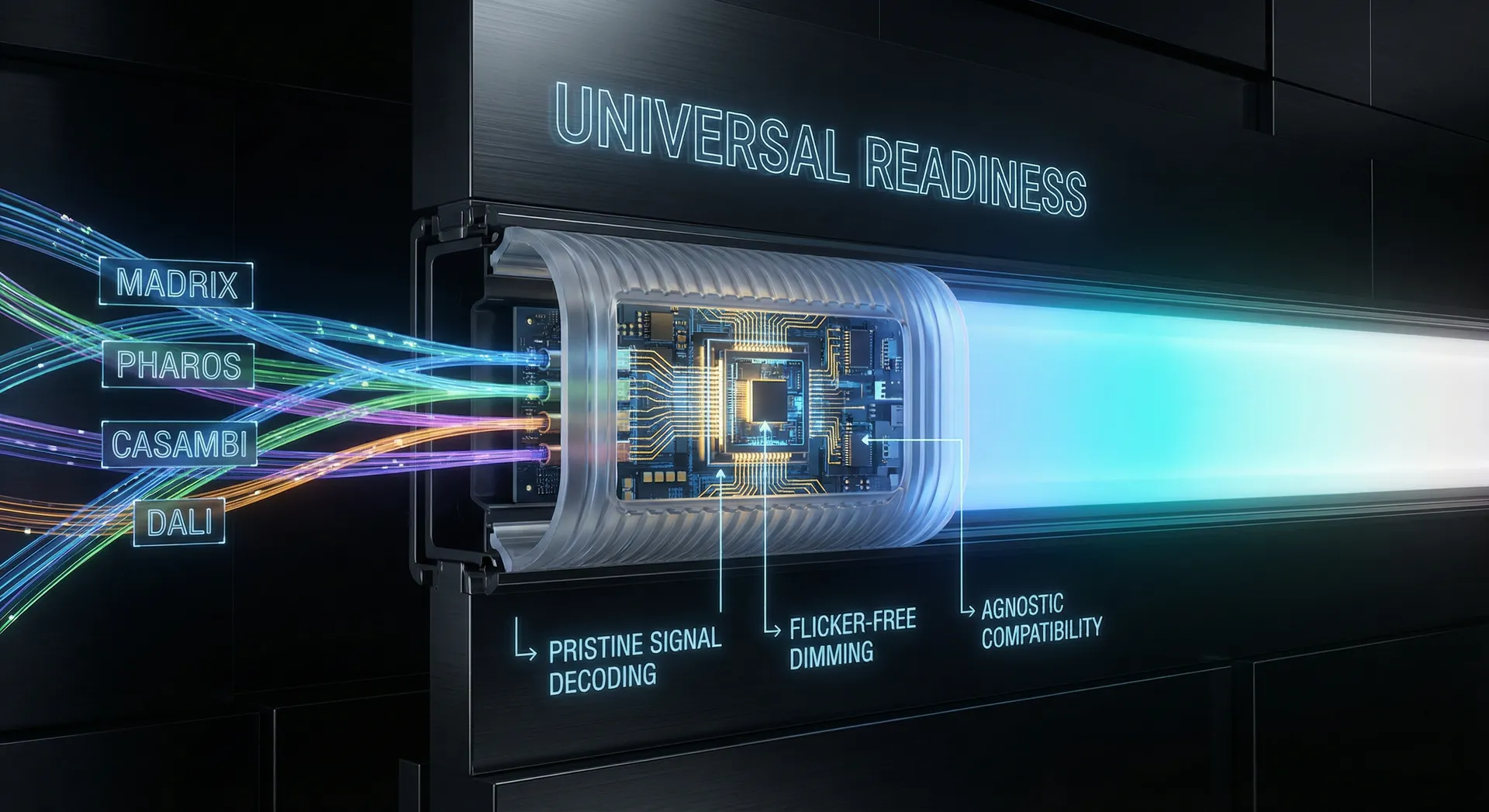
System integration is complex enough. The luminaires you choose shouldn't add to the headache. By focusing on uncompromising hardware quality and open-standard communication, JRLite ensures that when the "Presentation Mode" button is pressed, the light performs exactly as commanded.
Design the system. We’ll Light the Exceptional.
About the Column: The Digital Control series by JRLite explores the intersection of architectural lighting and system integration, helping professionals master the data, protocols, and digital hardware that bring modern spaces to life.


