

The Pressure Test
IP68 vs. IP69: The Most Misunderstood Ratings in Outdoor Lighting
Picture an expansive, interactive water feature in a newly revitalized civic plaza. The architect specified premium, IP68-rated linear lighting recessed into the stone steps. For the first few months, it looks spectacular, glowing beautifully beneath the shallow water.
Then comes routine maintenance.
To remove built-up algae, dirt, and urban grime, the city’s maintenance crew brings in industrial high-pressure power washers. They blast the stone steps, passing the powerful water jet directly over the linear lights. Within hours, half the lights short out, their internal cavities flooded.
The contractor is furious. “These are IP68! They are designed to be underwater! How did they leak?”
The answer lies in a widespread and costly industry misconception: the belief that IP ratings work on a simple, linear scale where "higher is always better." In reality, surviving at the bottom of a pool and surviving a power washer require completely different engineering.
To prevent catastrophic failures in the field, we must understand the distinct physics behind IP68 and IP69.
IP68: The Submarine (Static Hydrostatic Pressure)
When a product is rated IP68, the "8" indicates it is protected against the effects of continuous immersion in water.
The manufacturer and the testing lab agree on a specific depth and duration (for example, 2 meters deep for 24 hours). The forces at play here are hydrostatic. The water exerts a steady, uniform, static pressure squeezing the luminaire evenly from all sides.
If a luminaire passes this test, it is essentially a miniature submarine. It is perfect for swimming pools, fountains, and reflecting ponds. However, the water in this test is calm. It is not moving violently.
IP69: The Kinetic Hammer (Dynamic Force)
This brings us to IP69 (defined by the strict IEC 60529 standard for electronics, not to be confused with the automotive industry's IP69K). The "9" denotes protection against high-pressure, high-temperature water jets.
In this brutal test, the luminaire is blasted with water heated to 80°C (176°F) at a staggering pressure of 80 to 100 bar (1160 to 1450 psi). The nozzle is placed just 10 to 15 centimeters away, spraying from multiple angles.
The forces at play here are dynamic and thermal. The high-velocity water jet acts like a kinetic hammer, attempting to pry open microscopic seams, while the sudden application of hot water causes rapid thermal expansion.
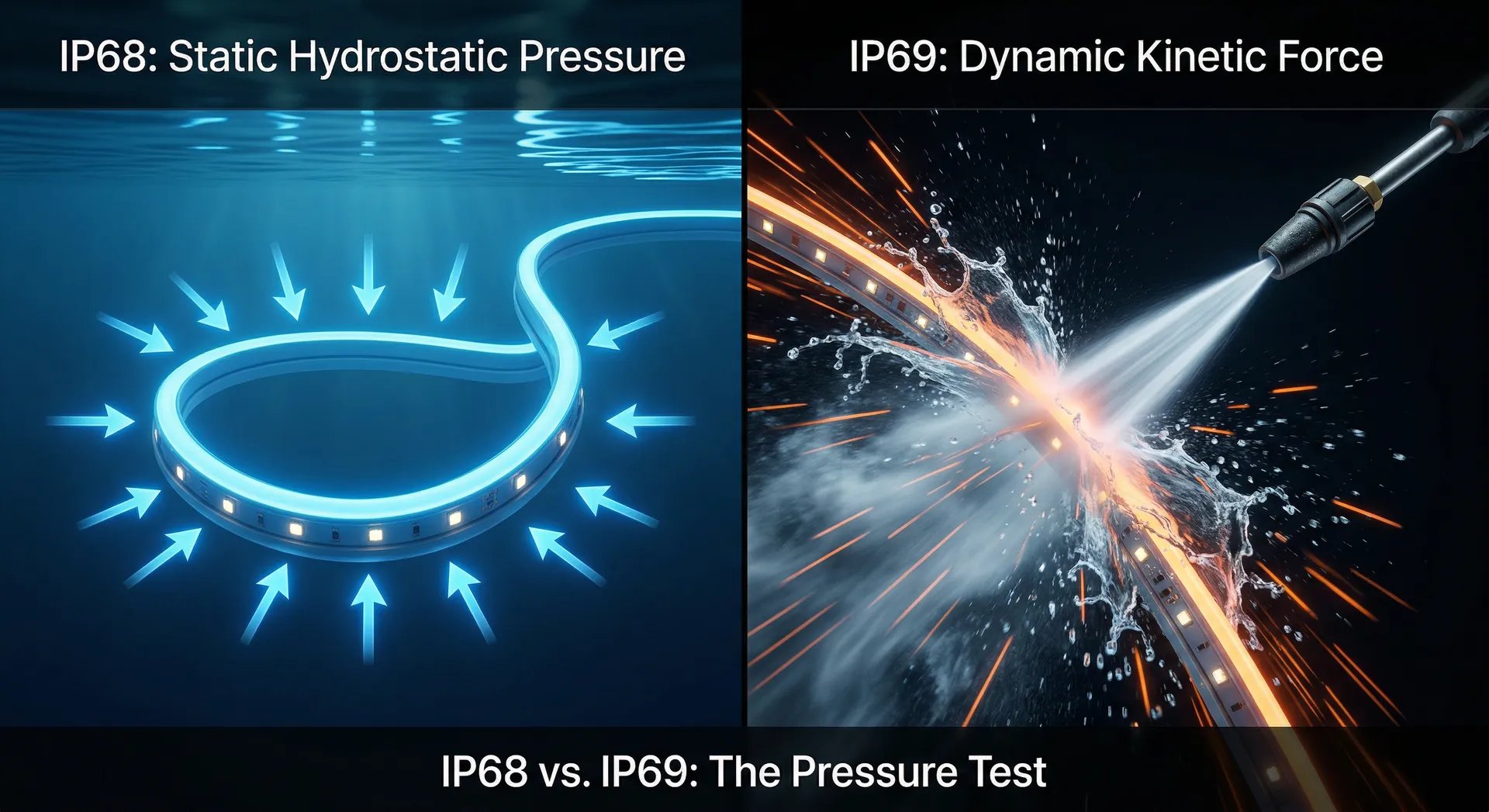
The Fatal Assumption
Here is the trap most professionals fall into: An IP68 rating does NOT automatically cover IP69, and an IP69 rating does NOT automatically cover IP68.
They are two parallel tests for two totally different environments. A submarine (IP68) can survive deep underwater, but its delicate external sensors might be ripped off by a concentrated, high-speed fire hose (IP69). Conversely, a deflector shield (IP69) can repel a fire hose, but if you leave it at the bottom of the ocean, water might eventually seep through its seams over time (IP68).
When outdoor landscape lights fail during power washing, it is because static IP68 seals are violently compromised by dynamic IP69 forces.
The Ultimate Defense: Engineering for Both Worlds
In high-end architectural and landscape projects, lighting fixtures don't get to choose which elements they face. They must survive the heavy rainstorms and standing water (IP68), as well as the aggressive mechanical cleaning crews (IP69).
At JRLite, we believe true durability leaves no room for "either/or."
This is why we engineered our premium WAVE Series to achieve a dual certification: IP68 & IP69. By utilizing high-density, co-extruded Dow® optical-grade silicone—which possesses extraordinary tear strength and thermal stability—combined with our monolithic, zero-stress encapsulation process, we eliminate all micro-seams and mechanical weak points.

Whether it is sitting silently at the bottom of a luxury resort pool, or taking a direct hit from a municipal power washer, the JRLite WAVE Series remains impenetrable.
Don't let maintenance routines destroy your masterpiece. Specify for the reality of the site, and Light the Exceptional.
About the Column: The Practical Guide series by JRLite translates complex lighting technology into actionable strategies, empowering architects, engineers, and lighting professionals to navigate real-world challenges with confidence.


