

The Invisible Art of Consistency
Chasing the Perfect White: A Designer’s Guide to the MacAdam Ellipse
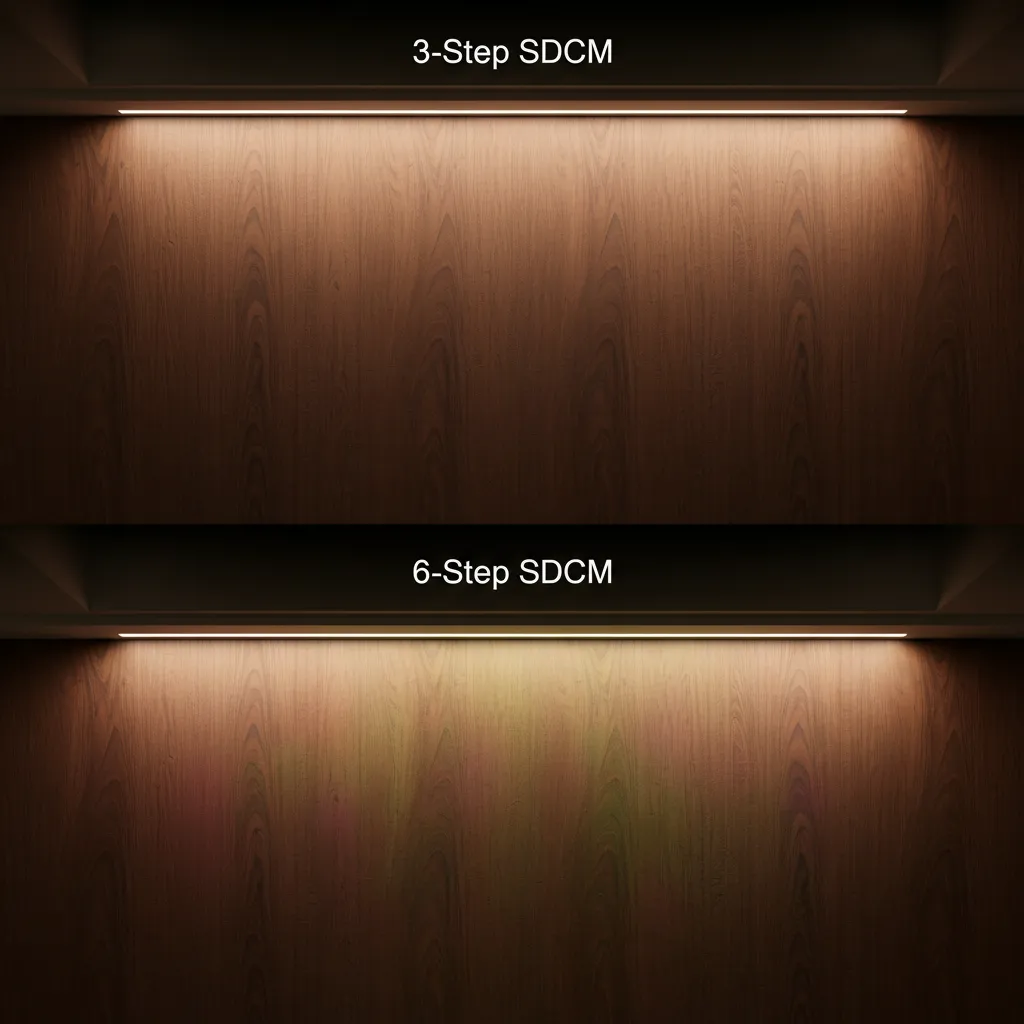
Imagine walking down the quiet, carpeted corridor of a newly completed five-star luxury hotel. The interior design is flawless: rich mahogany panels, brass accents, and a continuous architectural cove light illuminating the ceiling.
But as you look closer, the illusion shatters.
The first ten meters of the light cast a warm, inviting glow. But suddenly, the next section looks subtly pink. A few meters down, the light shifts again, taking on a faint, almost sickly greenish hue. The beautiful mahogany panels now look uneven and chaotic.
For an architectural lighting designer, this is a nightmare scenario. It’s not a failure of brightness or power; it’s a failure of color consistency. And it all comes down to a concept defined over 80 years ago: the MacAdam Ellipse
The Human Eye: The Ultimate Critic
In the 1940s, a brilliant scientist named David MacAdam conducted extensive experiments on human color vision. He discovered something fascinating but frustrating: the human eye is incredibly sensitive to slight variations in color, especially in shades of white.
If you put two slightly different white lights side-by-side, the eye will immediately spot the difference—even if a machine says they are nearly identical.
To map this phenomenon, MacAdam created a visual chart (the chromaticity diagram) and drew small, invisible boundaries around specific color targets. Inside these boundaries, all colors appear identical to the average human eye. These boundaries are shaped like ellipses.
Thus, the MacAdam Ellipse was born.
What is SDCM (and Why Should You Care?)
In the lighting industry, we measure how closely an LED matches its target color using SDCM (Standard Deviation of Color Matching). This is where the MacAdam Ellipse becomes a practical tool.
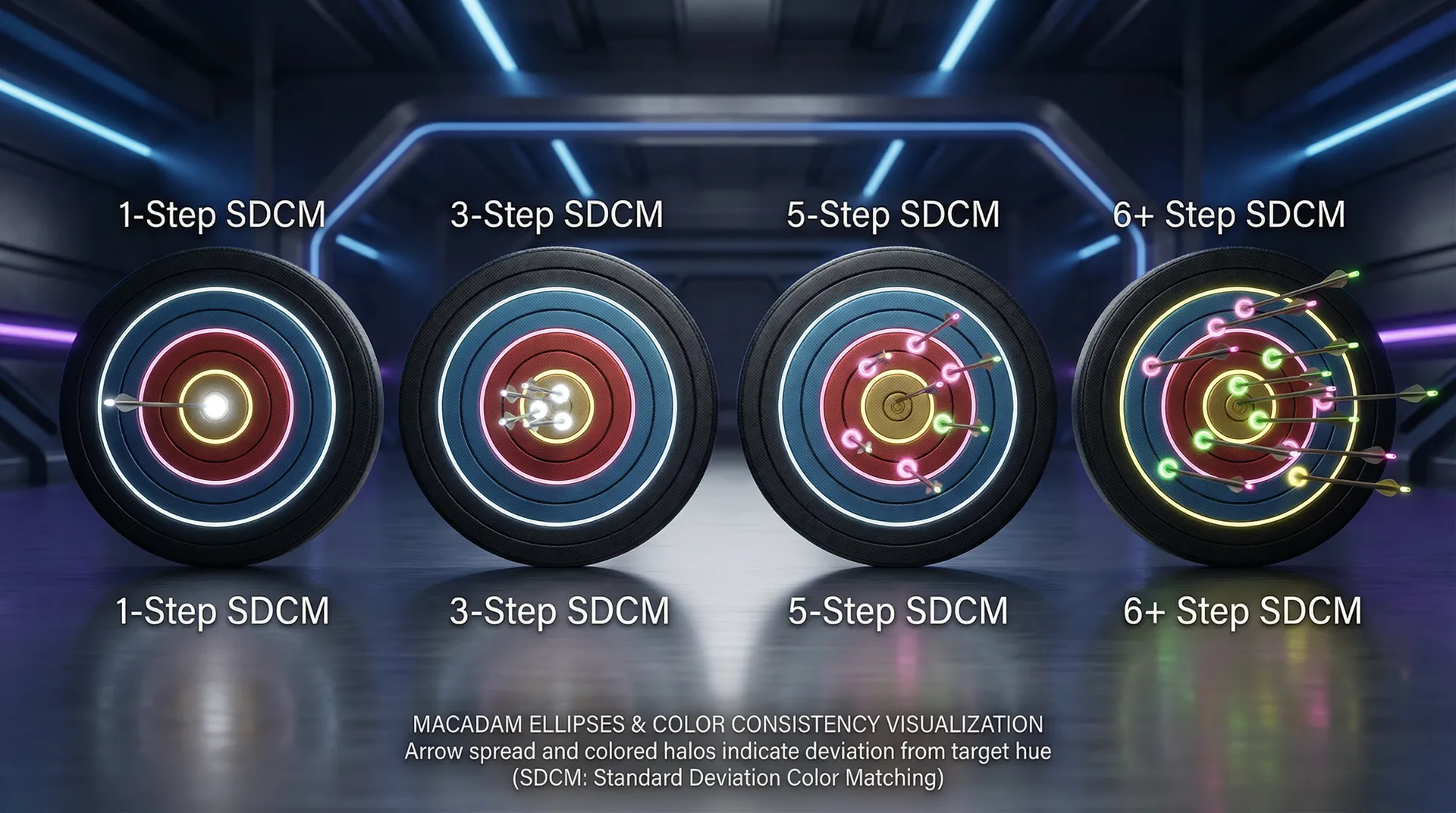
Think of an archer shooting arrows at a target:
1-Step MacAdam Ellipse (SDCM < 1): The bullseye. Every arrow hits exactly the center. In lighting, this means perfect color consistency. (However, mass-producing LEDs to this exact standard is incredibly difficult and expensive).
2-Step to 3-Step (SDCM < 3): The arrows are very tightly clustered around the center. The human eye cannot detect any difference between them. This is the gold standard for premium architectural lighting.
4-Step to 5-Step: The arrows are spreading out. If you place a 1-Step light next to a 5-Step light, a normal observer will clearly see a color difference. This is acceptable for cheap, commercial lighting where aesthetics don't matter, but unacceptable for high-end design.
6-Step and Beyond: The arrows are all over the target. You will see pinkish-whites, greenish-whites, and yellowish-whites.
The Linear Lighting Challenge
Why is the MacAdam Ellipse specifically critical for JRLite and the professionals who use our products? Because of the nature of linear lighting.
If you place a downlight in the kitchen and another in the hallway, they can be slightly different colors (e.g., 4-Step MacAdam), and no one will notice because they are far apart.
But with flexible linear lighting—like our LED strips and neon flex—the light is a continuous line, often running for 10, 20, or 30 meters. The LEDs sit millimeters apart. If one segment is SDCM 2 and the adjoining segment is SDCM 5, the visual clash is immediate and harsh.
In wall-washing applications, grazing light across textured stone or wood panels, poor color consistency will instantly destroy the material's premium feel.
The JRLite Standard: Light the Exceptional
At JRLite, we understand that for OBM clients and lighting designers handling flagship projects—from luxury hospitality to grand commercial complexes—"good enough" is a liability.
We don't leave color consistency to chance. Through rigorous "one bin only" processes (sorting LEDs by exact color coordinates), we ensure our premium architectural linear fixtures maintain a tight SDCM < 3 (and often tighter), batch after batch, year after year.
Because when you specify light to shape an exceptional space, the color shouldn't be a variable. It should be a promise.
About the Column: The Visual Tech series by JRLite explores the science, art, and engineering behind architectural lighting, empowering designers to make informed decisions for exceptional spaces.


